The Beauties of the Boyne and the Blackwater
William R. W. Wilde published The Beauties of the Boyne, and Its Tributary, the Blackwater in 1849. The book follows the Boyne from Trinity Well at Carbury to the sea below Drogheda. It brings in the Blackwater from Lough Ramor through Kells and Teltown to Navan. James McGlashan of Dublin issued it. Wilde dated the preface from 21 Westland Row in August 1849.
A second, enlarged edition came out in August 1850. The 1849 book already walks the battlefield at Oldbridge and names Mellifont and Monasterboice in the itinerary. Wilde then lengthened the battle and described the two monasteries more fully. He extended the routes for a visitor short of time and added eleven illustrations. The woodcuts then numbered eighty-four. William Frederick Wakeman drew almost all of them. He had been living on the banks of the Boyne, and Wilde credits him with local knowledge as well as the drawings. John O'Donovan revised the proofs. Dean Richard Butler of Clonmacnoise, who knew Trim and the history of Meath, read the book as a critic. Wilde did not present himself as an antiquary. He was a surgeon, and he wrote the book as a rest from that work.
The book was reissued in 2025 as The Boyne and Blackwater, a paperback of 326 pages with modern illustrations. Purchase at Amazon.co.uk or Amazon.com.
The original edition
James McGlashan of Dublin issued the first edition in 1849, with William S. Orr and Co. of London and Liverpool. Read or download the PDF (317 pages, 11.7 MB).
Where he places Brugh na Bóinne
Chapter VIII is the one that bears on Newgrange. Wilde calls it The Royal Cemetery of Brugh-na-Boinne. He works from the Senchas-na-Relec in the Book of the Dun Cow, in the translation printed in George Petrie's book on the round towers. He also uses the Dindsenchas in the Book of Ballymote. From those texts and from the monuments still standing, he takes the mounds, caves and pillar stones along the north bank, from Slane to Netterville, for the cemetery of the kings of Tara. He will not put it at Stackallan.
The story he uses is the burial of Cormac Mac Art. Cormac died at the house of Cletty and asked not to be laid at Brugh, which he called a cemetery of idolaters. He wanted Ros-na-Righ, with his face to the east. His people tried three times to carry him across to Brugh. The Boyne rose three times and stopped them, so they buried him at Ros-na-Righ, which Wilde identifies with Rossnaree on the south bank. Opposite that ford, on the rising ground, he finds the mounds, raths, caves and pillar stones. Knowth, Newgrange and Dowth are, in his phrase, the great pyramids of western Europe. Each stands within view of the others, about 1.6 kilometres (1 mile) apart.
Knowth
Coming downstream, he meets Knowth first. It is an abrupt mound with a flattened top, a cairn of small stones under turf, about 0.4 hectares (1 acre) in extent and nearly 24 metres (80 feet) high. Enormous stones stand in a circle round the base. Cuts in one side show the cairn, but he can find no way in, and he treats the interior as still unexamined. The annals are against that reading. Under the year 862 they record that the Danes broke into the cave of Cnodhba, which he takes for Knowth, along with the cave of Achadh Aldai and the cave over Dubhad, or Dowth.
Newgrange
Newgrange is the mound that stands open. Wilde puts the small stones at about 180,000 tonnes (180,000 tons), covering nearly 0.8 hectares (2 acres). He gives the circuit as 400 paces. The height is about 24 metres (80 feet) above the natural slope. Digging for building stone and road metal had already lowered it, and hazel had grown over the scars. A ring of detached blocks once stood a few yards outside the kerb, at intervals of about 9 metres (10 yards). Ten of them remained on the south-east side. A pillar stone, he says, once stood on the summit. Some of the great stones look water worn and may have come from the river. Others are not local at all. He names basalt, and rock he would bring from the Mournes.
He will not give Sir Thomas Molyneux the credit of the first account. The earliest description he prints is the letter Edward Lhwyd wrote from Sligo on 12th March 1699. Lhwyd had found the mound by then much as Wilde found it, with loose stones and animal bone on the floor, including pieces of deer's horn. Molyneux, writing later, added two unburnt bodies and a slender stone like a pyramid. Wilde does not find those in the earlier accounts, and he thinks the chamber had been entered long before 1699.
The mouth was still short of the outer circle. Brambles and loose stones choked it when he first came in 1837. A neighbour had lately cleared the opening and exposed the great carved slab. Spirals and volutes cover a stone about 3 metres (10 feet) long and 46 cm (18 inches) thick, of a greenish micaceous rock unlike the stones around it. Above it, the edge of another carved stone projected from the mound. Wilde measured that lintel at 1.73 metres (5 feet 8 inches). The cutting, he thought, was too fine to have been meant for hiding, and he guessed that it marked a way into some further chamber, as the pyramids of Egypt hold more than one room. Later writers called the slab a false lintel. It is the outer stone of the roof-box.
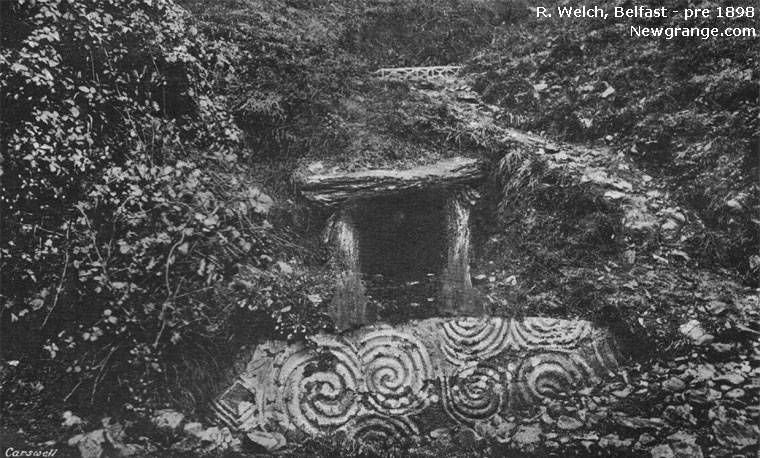 A 19th century photograph of the entrance at Newgrange, by R. Welch of Belfast. The carved stone and the
lintel above the doorway are the two stones Wilde described in 1849.
The passage faces the Boyne and runs nearly north and south. He measured it at 19 metres (63 feet), with twenty-one uprights on the right and twenty-two on the left. For most of its length it is about 1.8 metres (6 feet) high and 0.9 metres (3 feet) wide, and fallen stones force a visitor onto hands and knees. One roof flag is 5.2 metres (17 feet) long and 1.8 metres (6 feet) broad. Many of the side stones are polished where no visitor could have rubbed them, and some carry mortices near the edge, which he takes for the sockets of wedges used to split or lift the stone.
The passage rises into a domed chamber. Three recesses open off it, one opposite the entrance and one to each side, so that the plan, with the passage, is a cross. Eleven uprights form the wall to a height of about 3 metres (10 feet). Above them the stones step inward until one slab closes the top, 5.9 metres (19 feet 6 inches) above a floor of loose stones. From the entrance of the chamber to the far wall is 5.5 metres (18 feet). From the end of one side recess to the other is 6.7 metres (22 feet). The eastern recess is the largest, 2.4 metres (8 feet) deep, 2.7 metres (9 feet) high and 2.1 metres (7 feet) broad, and it carries the richest carving. He compares the roof with the corbelled domes of Saqqara, Dahshur and the tomb called the treasury of Atreus at Mycenae. The likeness, for him, is the principle of the roof, not the finish. The Greek dome was cut into a hillside and once lined with bronze. Newgrange was built, and then buried in the cairn.
In each recess he finds a hollowed stone basin, which he calls a rude sarcophagus. The eastern one is 0.9 metres (3 feet) long, with two smaller hollows in the bowl, and it sits inside a larger, shallower basin. The western recess has only one. He believes the basins once held human remains, though nothing of the sort survived in the chamber for him to see.
The carvings are double spirals, most of them with seven turns, together with lozenges, zigzags and lines in relief. Some spirals look to him like the setting out for work that was finished only on the entrance stone. A flag in the eastern recess, newly exposed where a jamb had fallen, still showed the fresh track of the tool, while the open carvings had darkened to the colour of the stone. From that, and from designs that run onto faces hidden once the stones were set, he argues that the cutting was done before the stones were raised, and perhaps for some earlier use. He asks whether they are ornamental or a record of the monument. He is inclined to take them as sacred carving, and he coins a word for them, tymboglyphics, tomb writing, because he has seen the same marks only on sepulchres, here, at Dowth and in Down and Donegal. Vallancey's followers had read one device in the western recess as writing. Wilde will not follow them, and he rejects the idea that the name New Grange comes from Grian, the sun. The name, he says, is English. The Boyne: A Valley of Kings returns to that question about the carvings.
Outside the mound he records a gold coin of Valentinian and one of Theodosius. A little west of the entrance a labourer found two gold torques, a chain and two rings. Wilde says they left the country. On the annals, he follows Petrie and O'Donovan in taking the cave of Achadh Aldai, plundered with Knowth and Dowth in 862, for Newgrange itself. How far before the Christian era the mound should be placed, he leaves open. It may, he thinks, stand as old as the pyramids on the Nile. Strip away the cairn and the dome, and restore the missing stones of the outer ring, and he says what would remain would not be unlike Stonehenge.
Dowth in 1847
Dowth, about 1.6 kilometres (1 mile) from Newgrange on a higher slope, was the more conical of the three. Lord Netterville had built a tea house on the summit. A gap in the western face had been open for years, where stones were taken for buildings and for the road at the foot of the mound. Wilde repeats the story, and hopes it is untrue, that the county grand jury once presented the stones of Dowth for road metal. A passage like the one at Newgrange showed in that gap, but it could not be followed far.
The Committee of Antiquities of the Royal Irish Academy got leave from the trustees of the Netterville charity, who held the estate, and put the work under Mr Frith, one of the surveyors for County Dublin. The Board of Works lent the tools. A shaft from the top and a tunnel from the side were both set aside, because the cairn was loose stones. They followed the western passage instead. The tea house had to come down. What they found was a set of chambers, where they had looked for one room at the centre. Wilde compares them with the rooms under the central chamber in the largest pyramid of the Saqqara range.
The passage he describes runs east, 8.2 metres (27 feet) long, with nine uprights on the right and eleven on the left, and leads to a cruciform chamber. The central room is an irregular oval, 2.8 metres (9 feet 4 inches) by 2.1 metres (7 feet). Sill stones stand at the mouths of the smaller recesses, set, he thinks, to stop the cairn pushing the walls in. Circles, zigzags and curves mark some of the passage stones. In the chamber he finds ornaments like wheels, concentric circles, lines radiating from a point and short parallel strokes that look to him like ogham. The Danes, he has already said, broke into Dowth in the ninth century. Whether the western gap was their breach, he cannot tell.
Down the two rivers
Wilde opens on the claim that he knows no part of Ireland where scenery and historic interest meet as they do on the Boyne. The river rises at Trinity Well near Carbury. He tells the story of Boann and her lapdog Dabella, and he sets the valley inside the old kingdom of Meath, with Dervorgilla as the Helen of what he calls the Irish Iliad. From Carbury the early chapters run by Edenderry, Kinnegad, where weapons and skulls had come out of the river, and Clonard, the school of St Finnian, with its font and the fighting of 1798.
Trim gets a chapter to itself. He gives the killing of Hugh de Lacy, the Yellow Steeple, Talbot's Castle as an early home of the Duke of Wellington, and Laracor, where Swift and Stella lived. Downstream are Scurlogstown, Bective, where he places de Lacy's burial, the subterranean chambers at Clady, and the house of Cletty. Tara comes in here, with the raths and the Lia Fáil, then Skryne, the font at Kilcarn and Athlumney Castle above Navan.
The Blackwater is a chapter of its own, from Lough Ramor and Virginia through Kells, with St Colmcille's house, the round tower and the great cross, to Tailteann, whose games, fairs and marriages he treats as one of the old seats of kingship. Donaghpatrick holds the story of St Patrick and King Loegaire. Back on the Boyne, the road from Navan passes the round tower at Donaghmore, Dunmoe and Beauparc to Slane. From the hill he sends the reader along the river to the three mounds. An itinerary at the front sets the same ground out for a visitor short of time, with Slane as the place to stay, and a day that can take in Knowth, Newgrange, Dowth, the battlefield, Mellifont and Monasterboice before the last train from Drogheda.
Oldbridge and Drogheda
The last chapter is the battle of 1st July 1690, fought on the old calendar. Wilde sets the Irish army on the south bank at Oldbridge and Donore. William's army is on the north, with a crossing higher up at Rossnaree that turned the Irish left. William was wounded by a shot the day before the battle. Schomberg was killed in the passage of the river. The numbers Wilde gives are upwards of a thousand dead on the Irish side and above four hundred on the English. The Irish wore white paper in their caps. The English soldiers wore green branches. James, he says, was back in Dublin about ten that night. The chapter then takes the river into Drogheda, the walls, St Laurence's Gate, the Magdalen steeple and the Maiden Tower at the mouth. Peter Harbison, in Treasures of the Boyne Valley, treated this book as the one that had already walked the ground.
Chapters
- The river's source and history, from Trinity Well and the story of Boann.
- From Carbury to Clonard.
- Clonard, and the Boyne on to Trim.
- Trim, the castle, Newtown and Laracor.
- From Trim to Navan, by Bective, Tara and Athlumney.
- The Blackwater, from Lough Ramor through Kells and Teltown.
- The Boyne from Navan to Slane.
- The royal cemetery of Brugh-na-Boinne, with Knowth, Newgrange and Dowth.
- The ethnology of the ancient Irish, and early forms of burial.
- The battlefield of Oldbridge, and Drogheda. The 1850 edition lengthens this chapter.
- Drogheda and its environs, with Mellifont and Monasterboice.
The author
William Robert Wills Wilde was born near Castlerea, County Roscommon, in 1815, and died in Dublin on 19th April 1876. He made his name as an eye and ear surgeon, and he compiled the medical returns for the Irish census. The knighthood came in 1864. In 1851 he married Jane Elgee, the poet who wrote as Speranza. Their son Oscar was born in 1854 at 21 Westland Row, the house named in the preface to this book.