The Boyne: A Valley of Kings
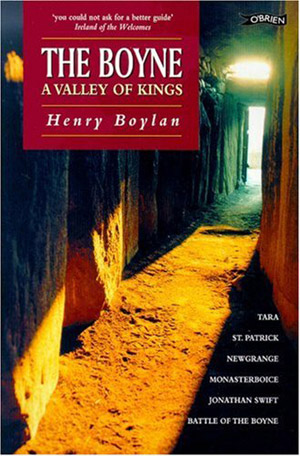
The Boyne: A Valley of Kings by Henry Boylan.
Ireland's Boyne Valley is an area of great historical importance, of fertile lands, ancient crosses, abbeys, castles and fine houses, a place where battles were fought and High Kings crowned. Its richly varied past is peopled with names such as St Patrick, Poynings, King William, Oliver Cromwell, Jonathan Swift, Lord Dunsany, Francis Ledwidge, and Admiral Francis Beaufort, deviser of the Beaufort Scale.
Following the course of the River Boyne from its source at Trinity Well in Co Kildare to the estuary at Mornington, where it enters the sea, this book visits the famous sites and ancient monuments, such as Newgrange, Tara, Kells and Monasterboice, to provide a narrative on the people, events and legends of the area.
Purchase at Amazon.com or Amazon.co.uk.
Brú na Bóinne
Just below Slane the Boyne sweeps round in a great bend, enclosing a royal necropolis, a city of the dead. In ancient manuscripts and in the oral tradition, this place is called Brú na Bóinne, “the palace of the Boyne”. In this semi-circle of broad green fields, two miles across, are found the great Neolithic passage graves of Newgrange, Knowth and Dowth. These are megalithic monuments, that is, they are constructed from large stones, many weighing more than ten tons. There are upwards of forty round mounds in all in this prehistoric cemetery.
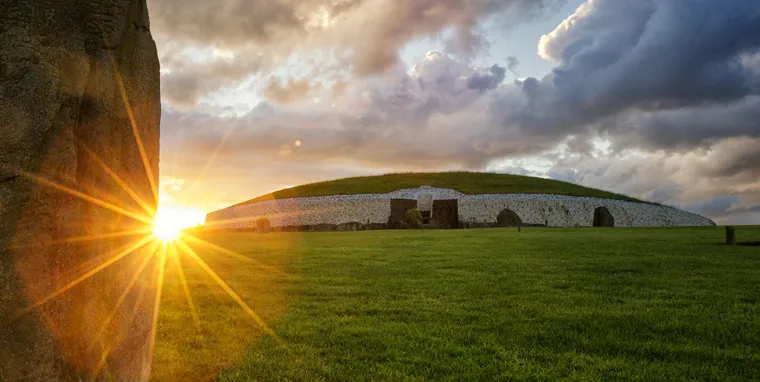 Newgrange passage tomb in the Bend of the Boyne | Brú na Bóinne World Heritage Site.
The first question that comes to one’s mind is: how old are these tombs? And then one asks: who built them and for what purpose? As to their age, modern techniques of radiocarbon analysis enable scientists to give approximate dates to remains, whether human or artefact. All organic material contains carbon, of which a known proportion is radioactive. After death, or in the case of pottery after firing, no new carbon is absorbed by the material and the radioactive carbon already present decays at a reasonably constant rate, which can be measured.
The scientist then determines the amount of radioactive carbon still present in these remains and from this information calculates how much time has passed since the death of the organism or the firing of the pottery. Other methods of dating include thermoluminescence and fission-track measurements. It must be stressed that these methods yield only approximations; nevertheless, scientists and archaeologists have come to the conclusion that these tombs are almost a millennium older than was first thought, and they now place them at around 3000 B.C., making them at least five thousand years old, older than Stonehenge and older by several centuries than the pyramids of Egypt.
Newgrange has been described as a cathedral of the megalithic religion. George Petrie, nineteenth-century antiquary, painter and musician, supported the claim of Newgrange to prehistoric antiquity, so as “to allow the ancient Irish the honour of erecting a work of such vast labour and grandeur”. And who were these ancient Irish, and for what purpose did they build? They were Stone Age people, who lived in substantial rectangular and circular wooden buildings. They used polished stone axes to clear the primeval forest, planted wheat and barley, and raised cattle, sheep and goats. They belonged to the Neolithic, or New Stone Age.
There is no evidence that Palaeolithic, or Old Stone Age, people ever came to Ireland. The earliest inhabitants were Mesolithic, or Middle Stone Age, people, who probably came over from Scotland about 6000 B.C. and made their largest settlements at Larne in County Antrim, where great quantities of flint were available. This material was as essential to these Middle Stone Age settlers as oil has become to their present-day successors.
They were hunters and fishers, and from the flint they fashioned axes and smaller tools. Great quantities of these tools, along with heaps of shells from oysters and mussels, have been found along the Antrim coast, but no trace survives of their houses or monuments.
The Neolithic people seem to have come over from Europe some time before 4000 B.C. They evidently devoted a great deal of their time and energy to the building of megalithic tombs. Over a thousand of these have survived the passage of four or five thousand years, and it is safe to assume that many more were built and have disappeared.
The different forms of these tombs, such as cairns, portal dolmens and passage graves, suggest that they were built by successive waves of settlers from abroad. These people can be called the first farmers in Ireland. In their comparatively settled way of life they acquired the arts of pottery making and weaving of textiles. It appears that they did not build their tombs until some centuries after their arrival in Ireland.
The earliest were the court tombs, so called because they included an open space, or court, leading into the gallery. There were many variations of this basic plan. Court tombs are found north of a line from Dundalk Bay to Galway Bay only. Pottery and flint arrowheads have been found in them, along with the ashes of the dead. Cremation was the normal method of burial, and the tombs usually faced east. Their origin and development are still a matter for debate; it seems clear that the burial of the dead was an occasion of some importance in the life of the community.
Portal dolmens are known in folklore as the beds of Diarmuid and Gráinne, fleeing from the wrath of Fionn Mac Cumhaill. Dolmen is a Breton word meaning “table”, but in fact these are megalithic tombs consisting of three or more standing stones covered by a large capstone, which can weigh up to one hundred tons. They are found mainly in Ulster, although there are some in south Leinster and Galway. The most impressive tombs are the passage graves, of which about three hundred have been found and recorded.
It is with a degree of awe that one approaches the great mound of Newgrange, remembering that it was constructed by our ancestors five thousand years ago. It comes as a shock to one who knew it thirty years ago to see the new façade of gleaming white quartz on each side of the entrance. The mound is built on a low hill about half a mile from the sweep of the Boyne to the south, hence its name in the ancient tales, Brú na Bóinne: the palace of the Boyne, residence of Aengus, the great god of love.
It is nearly forty feet high and about three hundred feet in diameter. It contains some 200,000 tons of earth and stone and must have required the labour of many hundreds of workers. They have been described as the first wage-earners in Ireland, who would have had no time to work their land. Payment would have been in kind, no doubt, although the fancy can run to visions of tokens for work done, to be exchanged for food and drink. So little is known with any degree of certainty about these builders that the temptation to let the imagination play around the subject is difficult to resist.
Walking up the hill to the mound, you first meet the survivors of a ring of pillar stones, some really enormous, which surrounded it. There are twelve left, out of an estimated thirty-five, and the sockets of some of the missing ones can be seen.
The base of the mound is supported by great kerbstones, eight to ten feet long, many bearing geometric decorations on both inside and outside faces. The stone marking the entrance to the tomb is sculptured with a triple spiral, double spirals, concentric semi-circles, and diamond-shaped motifs known as lozenges.
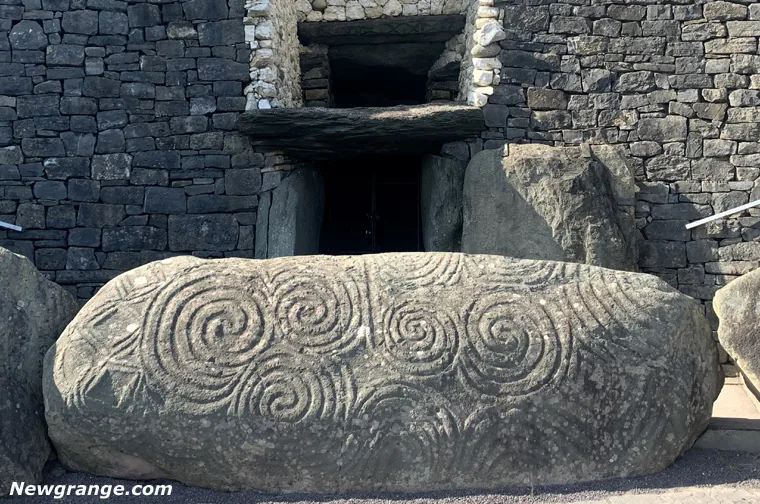 Newgrange Kerbstone K1, the Entrance Stone | Brú na Bóinne.
The mound is entered along a passage sixty-two feet long, lined with upright stones from five to eight feet high. The chamber at the end is circular in shape, with two side chambers and another at the end. The construction of the roof shows the skill of the builders. It rises to a height of twenty feet above the floor, using the technique called corbelling. Overlapping slabs were placed on top of one another until the space between the walls was spanned.
Burnt soil was packed into the gaps between the slabs and this soil was the source of the radiocarbon samples used for dating the structure. One single square slab at the top closed the last space. Layers of smaller stones and water-rolled pebbles were placed between the corbels. The weight of the roof and of the cairn above it crushed these stones so as to form a bed and thus distribute the stresses evenly. The builders ensured that no water would penetrate by cutting channels in some of the roof slabs and corbels. Water filtering down through the cairn is diverted away from the chamber, which shows no sign of dampness.
The side chambers contain large stone basins, one of which was carved from a block of granite from the Mourne Mountains, thirty-five miles to the north-east.
The most remarkable feature of this monument is the construction of the roof-box over the entrance and its alignment with the rising of the sun on 21 December, the winter solstice. If the day is clear, the rays of the rising sun will shine through the opening in the roof-box and penetrate along the passage right into the chamber. This phenomenon was first recorded by the late Professor M.J. O’Kelly during the winter solstice of 1969.
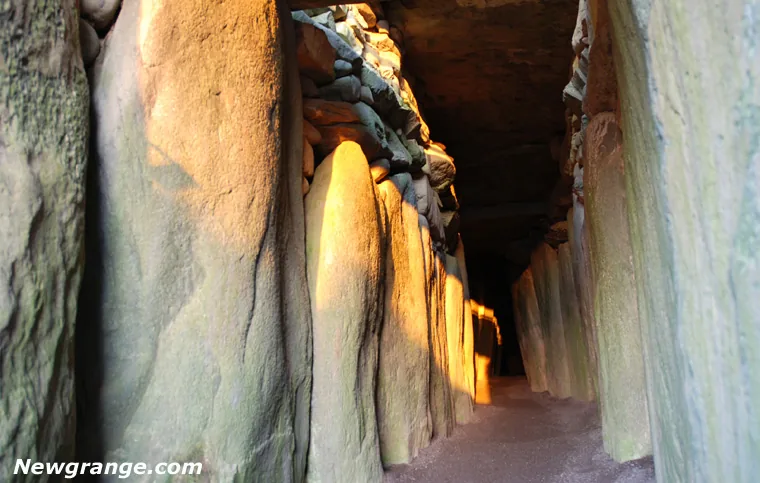 Winter Solstice sunbeam illuminating the Newgrange chamber.
A visit to Newgrange will make even the most prosaic of observers wish to know more about the monument itself and its builders. There has been no scarcity of comment and speculation since it was first “discovered” in 1699 by the Welsh antiquary, Edward Lhuyd. He dismissed it as “a barbarous monument”, and was equally unflattering about the entrance stone, “a great flat stone, like a large tombstone, placed edge-ways, having on the outside certain barbarous carvings, like snakes encircled, but without heads”.
Sir Thomas Molyneux, professor of physic in Trinity College, Dublin, visited Newgrange about twenty years later, but he too thought little of the decorations on the stones, describing them as “a barbarous kind of carving, showing not the least footsteps of writing”.
One who gave his imagination freer rein was Colonel Charles Vallancey, an early member of the Royal Irish Academy. In his Collectanea, a series of essays published during the years 1770–1804, he advanced theories about Irish history, and Newgrange in particular, which can charitably be described as eccentric.
His writings marked the origin of the “Romantic” school of archaeology. He concluded that Newgrange was a kind of temple devoted by the Tuatha Dé Danann to the worship of Mithras and argued that the famous carving in the chamber, sometimes called the “ship”, was in fact the name Mithras. He also propounded the derivation of the name Newgrange as a corruption of Grian-uagh, that is, the uagh, cave or den of Grian, i.e. Mithras or the sun.
Had he lived in the following century he might have heeded the warning of John O’Donovan, one of Ireland’s greatest scholars, that the most plausible derivation of an Irish placename is sure to be wrong. It is now accepted that the name Newgrange goes back only to medieval times, when the land on which the monument stands became one of the “new granges” of the abbey of Mellifont. Outlying farms attached to Cistercian monasteries were commonly called granges.
There is frequent mention of Brú na Bóinne in manuscripts dating from the tenth century onwards, and there can be little doubt that it had a central part in oral tradition for many centuries preceding the commitment of the legends to writing.
These Boyne passage graves were particularly associated with the Tuatha Dé Danann, people of the goddess Danu, who ruled Ireland before the coming of the Celts. Brú na Bóinne was the palace of the benevolent Dagda, his consort Boann, the river Boyne, and his son Aengus, the god of love and protector of lovers. It was sometimes called “Caiseal Aengusa”. In the thirteenth-century Book of Ballymote, the scribe records that the hosts of great Meath are buried in the middle of the lordly Brugh. It was the traditional burial place for the kings of Tara.
Sir William Wilde showed more intellectual curiosity about the carvings than most of his predecessors. “Are they mere ornamental carvings?” he asks, “or are they inscriptions from which the history of this monument, or whatever it was originally for, might be learned? Are they ideographical or hieroglyphic?”
One manuscript is translated as follows by Standish Hayes O’Grady in Silva Gadelica: “Ireland’s three undeniable eminences, Dumha na nGiall, the Mound of the Hostages in Tara, Mac an Óg’s Brugh, brilliant to approach, and Crimthann’s dún on Édar.” “Brilliant to approach”: the very size and situation of the monument suggest strongly that it was not intended solely or merely as a tomb. And so the argument rages.
The mystery of the rock carvings remains unsolved, but speculation, informed or otherwise, has widened considerably since they were dismissed by Lhuyd as barbarous. Some commentators believe that they are merely ornamental; others consider that they must constitute some kind of writing. Modern authorities incline strongly to the view that the designs must have symbolic significance, but they stop short of ascribing a meaning to them. One thing is certain: these carved stones have a haunting beauty that could not be the work of barbarians.
The ornamentation is abstract and geometrical. The designs consist of chevrons, spirals, lozenges, circles, arcs and lines. The workmanship on those slabs which are hidden behind others is inferior and suggests that they were entrusted to apprentices or perhaps to less skilled workmen. The fine craftsmanship of the superb entrance stone and of the kerbstones indicates that this work was carried out by highly skilled masters.
The most daring and imaginative attempt to solve the mystery of these carvings has been made by an American scholar, Martin Brennan. In The Boyne Valley Vision (1980), he sets out his conclusions from two and a half years of research. They are that, at a very early date, Neolithic geometers in the Boyne Valley had fully worked out the application of the geometry of the circle and the sphere to solving astronomical problems; that the stones are the repository of an entire cosmology, a vocabulary of symbols, the sundial, the calendar and other scientific tools of this, the oldest culture known to us in Ireland. His study included the carvings found at Knowth and Dowth.
Professor George Eogan, who is directing the work at Knowth, has recently published an absorbing account of his investigations to date, with particularly fine photographs. He has discovered two passage tombs in the mound, one facing east and the other west. Excavating was begun more than twenty years ago, and it will probably need another five years to be completed. This may seem inordinately long, but it must be remembered that the work by its nature must be confined to the summer months, and that a wet summer can cause vexatious delays, as an open wet site makes for extremely difficult working conditions. Great care is required to avoid the slightest damage to the monument or any artefacts that may be found there.
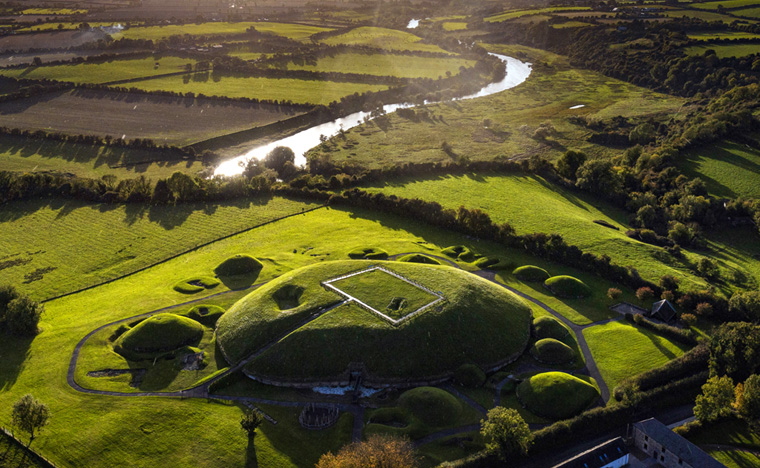 Knowth and the River Boyne | Brú na Bóinne World Heritage Site.
The excitement of the discovery of the tombs is well conveyed in Professor Eogan’s account. The very size of the monument and of the great stones used in its building have drawn from him the observation that such constructions demanded extraordinary commitment from what must have been an imaginative, intelligent and inventive people. Five thousand years ago neither cart-horses nor wheeled transport were available in Ireland. The stones, weighing four tons or more, were dragged a distance of several miles from the quarry to the site on wooden rollers or sledges, or simply dragged along the ground, using ropes made from twisted or plaited hide thongs.
It has been estimated that it would take eighty men up to four days to bring a four-ton stone to Knowth from a quarry three kilometres distant. About 1,600 stones, ranging in weight from one to several tons, were used in the making of the tomb. These Neolithic people built their houses of wood, and a good deal of timber must have been used in making the tomb, apart from rollers, sledges and levers, but no trace remains of this material.
The most striking of the grave goods found at Knowth is a decorated macehead, three inches high, fashioned from flint. The main motif on one side has the appearance of a stylised human head. Great skill and patience were required from the craftsman-artist in shaping the artefact and then working the relief ornamentation, using only a stone tool.
This is just one example of the art found there, which is so profuse that Professor Eogan declares that Knowth possesses Europe’s greatest concentration of megalithic art. This art, found mainly on the lintels, corbels, kerbs and other great stones which form part of the structure, consists of geometric and other abstract motifs. Its non-representational character makes it more difficult to assign a purpose to it with certainty, but most commentators now ascribe a form of religious symbolism to these designs. Knowth is particularly rich in decorated stones, possessing about one hundred more than are in all the other tombs in Brú na Bóinne put together.
As these excavations proceed and more is learned about the people, an increase in knowledge brings with it an increase in speculation. Following his detailed description of the tombs, Professor Eogan is moved to write: “A splendid and infinitely great monument like Knowth was probably intended as more than just a tribute to the dead. It could have been a receptacle or treasury for the emotions, feelings and thoughts of the clan, while its building was perhaps an act of faith in the future and in the continuation or prolongation of that society.”
And again he writes: “For the late Stone Age, Knowth was one of Europe’s greatest public buildings. To describe it as a massive and majestic megalithic masterpiece that reflected the pride and pomp of contemporary society is not an exaggeration.” And this at once leads us to ask: what happened to this society, this living society that created a monument that has endured for five thousand years? It cannot have been a natural disaster, a tidal wave or earthquake that destroyed it, for the tomb could not have survived such a catastrophe. The dying-out of that society is as great a mystery as its beginning. But then, many civilisations have blazed like stars in the firmament, and then collapsed, leaving ruined temples, palaces and tombs to inspire moralising texts in later generations.
Work is still proceeding at Dowth, but from excavations to date it appears that this is not as fine a monument as its neighbours, Newgrange and Knowth. It is one of the earliest passage tombs in Ireland and the decoration is inferior; this prehistoric art seems to have reached its finest flowering in the adjacent tombs.
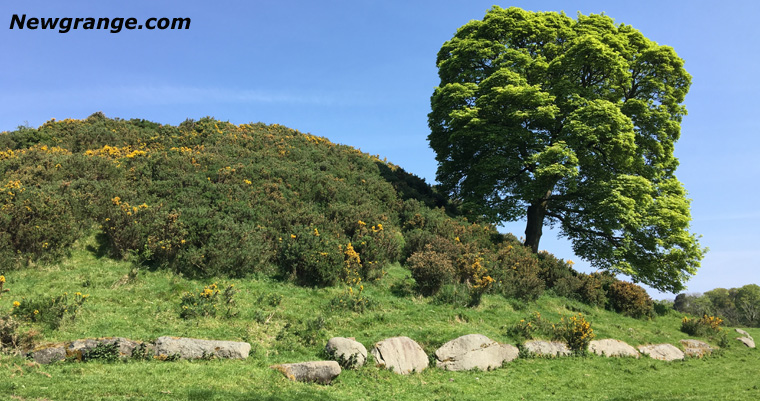 Dowth Megalithic Passage Tomb in the Boyne Valley, Ireland.
The symbolism of the great monument seems to be embodied in this light, a message of hope and spiritual renewal. And, indeed, in 1987 the government approved a proposal to create a National Archaeological Park in the Boyne Valley on a seven-hundred-acre site embracing the megalithic tombs at Newgrange, Knowth and Dowth.