Earthing the Myths
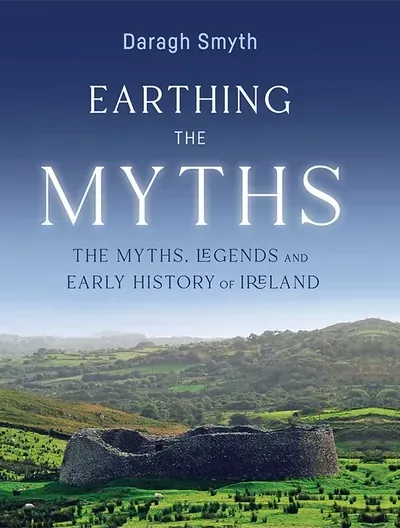
Earthing the Myths by Daragh Smyth is a county by county guide to places in Ireland where myth, folklore and early history occupy the same ground. Irish Academic Press published it in October 2021 and presents it as the first guide of this kind for the whole of Ireland. The entries move through the four provinces, and a further section takes in related sites in western Scotland.
More than a thousand locations are recorded, from Rathlin Island off the Antrim coast to the Beara Peninsula in the south west. Smyth works mainly from about 800 BC to AD 650, through the Late Bronze Age, the Iron Age and the early Christian centuries. Druids, fairies, goddesses, warriors and kings turn up in tales that are sometimes a record of events and sometimes a story a place has been made to carry.
The paperback edition runs to 392 pages and is illustrated. Purchase at Amazon.com or Amazon.co.uk.
Reading the ground
Trevor Parkhill, reviewing the book in Familia, described a handsome illustrated guide to archaeological sites across the island, with the legends told alongside them. He thought it could become a work of reference. The well known places are here. The Giant's Causeway, Croagh Patrick, the Hill of Tara and Brú na Bóinne all appear, and so do quieter spots, among them a whitethorn north of Roscrea in Co. Offaly called St Kieran's Bush, still hung with rags.
A passage tomb and a fairy thorn can share a county chapter because both are ways people have marked the land and kept a meaning for it. Smyth's earlier book, Cú Chulainn: An Iron Age Hero, had already followed one figure across that ground. Here the net is wider. Elsewhere he follows Cú Chulainn from the defender of Ulster in the older tales to a later emblem of resistance to English rule.
County Meath
Smyth opens the Meath chapter with the old name Mide, the middle. The county is An Mhí today. Meath gave its name to the historical fifth province, and he treats two places as its centres of early history and myth. Newgrange is the religious centre from the Neolithic. The Hill of Tara was once the royal capital. The monuments are far older than the centuries he takes as his main frame, from about 800 BC to AD 650. The stories attached to them arrive later.
The River Boyne
The River Boyne reaches the Irish Sea about 6 kilometres (4 miles) east of Drogheda. Smyth takes the name from Boand, the white cow goddess. Two rivers meet in the middle of Navan. One is the Bó Gúairi, which he identifies with the Blackwater, flowing from Lough Ramor. The other is the Find, his name for the upper Boyne before that junction. He notes Bealach na Bó Finne, the Irish term for the Milky Way, as a link between Newgrange and the sky. Brú na Bóinne, the dwelling place of the Boyne, is the landscape of the great passage tombs at Newgrange, Knowth and Dowth.
Newgrange, Knowth and Dowth
He sets those tombs in a farming tradition that runs from about 3500 to 1500 BC. For more than 2,000 years the dead were laid in chambers of upright stones, roofed with lintels or corbels. The mounds, in his view, were keepers of a culture as well as places of burial, a Late Neolithic and Early Bronze Age one, much as a church holds more than graves.
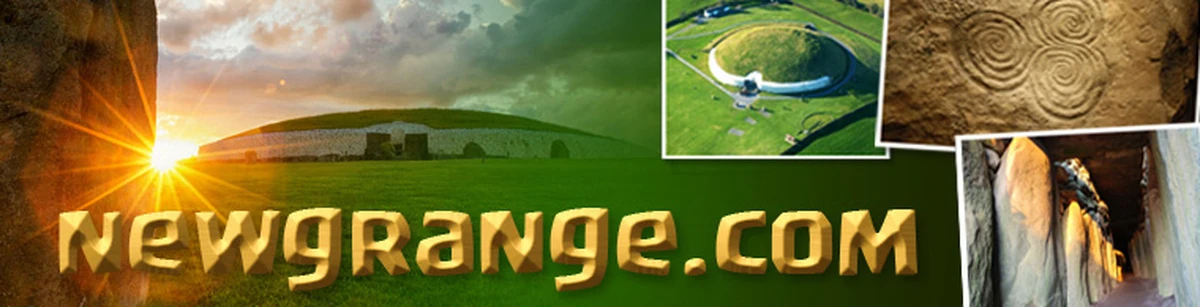
The Newgrange mound is nearly 91 metres (100 yards) across and about 14 metres (45 feet) high. At the winter solstice the first sunlight travels down a passage of about 19 metres (62 feet) and lights the chamber. That sunrise fixes the shortest day and, as Smyth reads it, the base of a farming year. He suggests that the sun in the passage stood for the land and its livestock being conceived again. East of the mound, a cursus may have been used for processions at the solstice. He compares it with the cursus north of Tara, long called the Banqueting Hall, which he thinks may have been an assembly place for the bull feast and for the inauguration of kings.
Ninety-seven kerbstones ring the mound, and twelve of them carry symbols. On the entrance stone, K1, a pair of vertical lines divides the spirals. Three large anticlockwise double spirals stand to the left, and two smaller clockwise spirals stand to the right. Smyth follows N.L. Thomas, who took the larger spirals for the long days of summer and the smaller ones for the weak winter sun, and who paired K1 with K52 on the opposite side of the mound. The solstice sun rises over K1. Thomas held that those designs were cut when the mound was built, or the passage would not sit on the chosen line, and he called the Irish calendar of about 3500 BC an early attempt to measure the year.
Knowth lies a little over 800 metres (half a mile) north west of Newgrange. Smyth counts nineteen megalithic tombs there, with Site 1 at the centre of the cemetery. Excavation found Beaker flint and pottery, along with cremations and with houses of both rectangular and oval plan. George Eogan, who excavated Knowth, thought the rectangular houses were the earlier ones. Dowth is close to Newgrange in size, about 14 metres (47 feet) high and 85 metres (280 feet) across.
Beaker pottery turns up at Newgrange as well as at Knowth. The name comes from a drinking cup. Smyth quotes R.A.S. Macalister, who traced the Beaker people to the east of central Europe and who in 1932 knew only four Beaker sites in Ireland, against a 1918 map that showed none. Many more have been found since the 1980s. One suggestion in the chapter is that Wicklow gold drew Beaker groups to the east coast, and that they, like the Tuatha Dé Danann of legend, may have reached Ireland from northern Scotland in the Bronze Age.
Aengus, the Dagda and Boand
The tombs are Neolithic. The stories, Smyth says, come in from the Late Bronze Age and the Iron Age, and then in manuscripts written by monks after St Patrick's time. Until that writing, the valley had monuments and no recorded memory.
He follows Geraldine Stout in placing the Brug of Aengus mac ind Óc in the Boyne Valley. The Dindshenchas calls Newgrange Tech Mic ind Óc, the house of the Mac ind Óc, and Síd i mBruig Mic ind Óc, the fairy mound in that Brug. Site P, which she names Caiseal nOengusa, the cashel of Aengus, is a large embanked enclosure about 800 metres (half a mile) from Newgrange. Aengus, harper to the gods, tricked his father the Dagda out of the sacred ground. Smyth calls the Dagda the Irish Zeus and a sun god.
He then offers a mythic reading of the solstice. The Dagda, as the sun, enters Newgrange and meets Boand, the white cow goddess, whom Smyth takes as the moon. From that meeting come the soil and the year. In the human telling, the Dagda lies with Boand, wife of Nechtain, and she bears Aengus, who becomes lord of the Boyne monuments.
Rossnaree
South of the river, Rossnaree is tied to Cath Ruis na Ríg for Bóinn, the Battle of Ros na Ríg on the Boyne. It is a fight after the Táin, and Ulster defeats Connacht, Leinster, royal Meath and Munster. MacNeill treated the tale as one of the old stories inside the Táin. Rudolf Thurneysen called it a romantic invention with no historical value, and Smyth notes that Keating does not mention it.
Little of that importance shows on the ground now. The headland, in this account, was the home of King Dathí's mother and the burial place of Cormac mac Airt. The mound said to be Cormac's was destroyed in the 1940s, and a woman's body was found there. Conn of the Hundred Battles, Conn Cétchathach, is said to have been killed at Rossnaree. The south bank was remembered as a Christian place, set against the older tombs on the north side, with links to Saints Fintan, Finnian and Colum Cille. Colum Cille is said to have found Cormac's skull and put it back in the grave.
Cormac, the story goes, died at Ráith Speláin, the fort of Spelán, at Cleitech, south of the Boyne near Stackallan Bridge, when a salmon bone stuck in his throat. He refused burial in Brú na Bóinne because he did not worship the god of those buried there. Later writers took that refusal as a glimpse of Christianity still to come. The annals place his death in the first half of the second century AD.
Tara
Tuathal Techtmar, a high king of the second century, is the figure Smyth credits with making Meath. The Book of Invasions says he cut a piece from each of the four provinces so that the new territory could support the kingship. Tara is where the high kings were inaugurated.
The annals and the Dindshenchas give the hill a Gaelic origin. Asked where the name Temair comes from, the Dindshenchas answers that Tea, daughter of Lugaid and wife of Éremón, son of Míl, was buried there, and that Teamhair is Múr Tea, the wall of Tea. Smyth also sets out a newer reading from Bhreathnach and Newman in Archaeology Ireland. They connect Temair with an old root meaning to cut, the same root as Greek temenos and Latin templum. A temenos was a sanctuary and a templum a temple. Cutting a ditch around the crown of the hill, they suggest, severed the ordinary world from the world of the gods. Cormac mac Cuilennáin, king and bishop of Cashel in the tenth century, took Tara for another word for a grianán, a balcony open to the sun. Smyth reads that as a trace of sun worship, along with royal names such as Lugaid, from the god Lug.
Another sense of Temair in the chapter is a gate to the Otherworld. He points to a rath called Deisel Temrach, right hand to the sun, a lucky place from which to enter that world. On George Petrie's map of 1838 it lies between the cairn of the Leinstermen and the cairn of the O'Neill, about 1.6 kilometres (1 mile) north of Ráth Gráinne in Jordanstown. It is missing from the Ordnance Survey map of 1837, perhaps because the survey stopped at Fán na Carpat, the slope of the chariots. The rite he attaches to the rath is a sunwise walk before death.
He counts about twenty high kings at Tara before St Patrick. Several, he says, were of stock from before the Gaels, among them Conaire Mór, Tuathal Techtmar, Lugaid Mac Con, Eochaid Mugmedón and Niall of the Nine Hostages.
The inauguration he describes starts at the Rath of the Synods, passes a sheela-na-gig later called Adomnán's Cross, then two small portal stones, and goes on to the passage tomb known as the Mound of the Hostages. The Lia Fáil, the Stone of Destiny, stood on that mound. The king stood on the stone and turned three times to the right, acknowledging the sun. If the stone cried out, he was the rightful king and could keep the fír flathemon, the justice expected of a king. Before the kingship he had to unite with a goddess of sovereignty. Smyth names Medb, and also Eithne.
A last Tara rite in the chapter is the tarbfeis at the Rath of the Synods, from a time when a dream chose the king. In the story he tells, the man in decline is Cú Chulainn and the man chosen is Lugaid Riab nDerg, Lugaid of the red stripes, even though the provinces had meant to shut Ulster out.
He also records fairy lore collected by W.Y. Evans-Wentz. At Ringlestown, about 3 kilometres (2 miles) south west of Tara, John Graham was said to have heard fairy music, and a tribe of little red men were said to live in Glen Odder, between the hillfort and Tara. The fort is a little under 120 metres (400 feet) across. John Boylin of Kilmessan, speaking around the start of the twentieth century, told of warrior fairies who would defend Tara against Cruachain, and of a night procession from Rath Ringlestown that no house or road was to cross. Hugh O'Neill camped there with his army in 1599. One story says the dead in the rath helped him.
Tlachtga and Teltown
Tlachtga, the Hill of Ward, stands near Athboy, about 10 kilometres (6 miles) north west of Trim. Athboy's older Irish name is Áth Buí Tlachtga, the yellow ford of Tlachtga. What remains is a ringfort of several banks, nearly 150 metres (500 feet) across. He credits its founding to Tuathal Techtmar, who led a Gaelic invasion about AD 80, defeated the Dál nAraide, or Cruithin, and imposed the Bóroma, the cow tribute of Leinster. Tlachtga was one of four forts Tuathal built.
The Fire of Tlachtga was lit there on the eve of Samhain, and the hill became a place of druid assembly. Dinneen's translation of Keating says the people burnt their victims at that fire. Smyth prefers to read the Irish as offerings burnt at the fire, and he leaves the question of human sacrifice open. He notes what Caesar wrote about sacrifice among the Gaulish druids and what the poet Sopater wrote about the Galatians. After the ceremony, any new fire had to be taken from the Tlachtga flame. A small payment called a screpall went to the king of Munster. The hill is also the goddess Tlachtga. She bore three sons, each by a different father, and died in the birth.
Tuathal is also given the fort at Teltown, Tailtiu, about 6 kilometres (4 miles) from Kells on the Slane road, a short way to the south of it. Locally it is Ráth Dubh, the black fort. The name comes from the goddess Tailtiu, who cleared the wood of Coill Chuan and asked to be buried on the plain she had made. She wanted funeral games each year. Her foster son Lug held them for a week before and after Lughnasa, the first of August, including a horse race. The assembly, Óenach Tailten, met on the north bank of the Blackwater and drew people from Ireland and Scotland. Marriages were made in a hollow set aside for them. Smyth sets Tailtiu beside the great fairs of Cruachan and Carman. Tailtiu was held every year at the start of August. Carman was held every three years.
He follows the games into the twentieth century. On 2nd August 1924 the Tailteann Games were revived at Croke Park, opened by W.B. Yeats, with athletes from many countries and a hurling match against Scottish shinty, which Scotland won. Pig sticking, part of the old games, was not on the programme. The banquet was by candlelight because the municipal workers were on strike.
Tuathal's victory, in this telling, was at Achall, about 1.6 kilometres (1 mile) east of Tara, now Skreen, or Scrín Cholm Cille. There he routed Elim mac Conrach and the aithechthúatha, the vassal tribes who were not counted among the Gaels.
Ardbraccan and Dún na nGéd
At Ardbraccan, Ard Breacáin, the height of Breacán, about 5 kilometres (3 miles) west of Navan, Smyth places one of the five sacred trees of Ireland. The Bile Tortan was an ash in the land of the Uí Tortain. The Book of Leinster describes it as an ash in arable Tortan. A bile was the tree of a people, where kings were inaugurated and gatherings were held.
The Banquet of Dún na nGéd, the fort of the geese, is a tale John O'Donovan translated in 1842 from a manuscript of the fifteenth century. It is also in the Yellow Book of Lecan, from the twelfth century. The people in it are historical. In the seventh century Congal Cáech, a Cruithin king of Ulster, faced Domnall mac Áedo of the northern Uí Néill, then king of Tara. Smyth cannot fix the fort. Edmund Hogan thought it the large fort on the south bank of the Boyne near Dowth. Domnall is said to have copied Tara, with seven ramparts and a banqueting hall. Smyth notes the awkward fit. Tara's so called Banqueting Hall looks like a cursus, and the site of Dún na nGéd itself is still a guess.
The candidate he offers is Platin, an inland promontory fort on a rock outcrop, under 5 kilometres (3 miles) south east of Dowth. It covers about 0.8 hectares (2 acres), with a raised circle a little over 24 metres (80 feet) across. The site is unmarked, and he is not sure it is the fort of the saga. Promontory forts are usually placed in the Iron Age, from about 300 BC to AD 500, which would make a foundation by Domnall roughly a century late. Older traces are there too, a Neolithic house and a fulacht fiadh, a cooking place of a kind used from the Bronze Age into historic times. Platin would also have served as a meeting place for the Cruithin.
Domnall did not stay. He moved his court to Ard Fothaid, near Donegal, and the Annals of the Four Masters record his death in 639. The tale leads on to Cath Maige Rath in Co. Down in 637, and to the fading power of the Dál nAraide. The insult at the centre of the feast is small and exact. Goose eggs on silver dishes went to the other guests. Congal was given a hen's egg on a wooden dish, and his seat beside the king went to Máelodar Macha, king of Airgialla. Gearóid Mac Niocaill thought the slight might rest on something that happened. Smyth uses the story to show a bardic tale naming real people and still telling history as a story.
A book to return to
The arrangement is practical. A visitor can start with Tara and the Bend of the Boyne, then take the same habit of reading into Louth and the Cooley mountains, where the Táin has its own geography. Late Bronze Age and Iron Age sites, early churches and the stories told about them sit together as a record of how the land was lived in and how it was imagined.
Belief in the fairies lasted into recent memory in parts of Ireland, and a cloth tied to a thorn is still a thing you can go and see. The guide keeps those places because they belong to the same long custom of marking ground. From Rathlin to Beara, that custom is part of the history the book sets out to record.
The author
Daragh Smyth is a retired lecturer from the Dublin Institute of Technology, where he ran the Erasmus programme and taught Irish cultural studies to students from Europe, Australia and North America. He was among the founders of Saor Ollscoil na hÉireann, the Free University of Ireland. Earthing the Myths follows two earlier books from Irish Academic Press, A Guide to Irish Mythology (1996) and Cú Chulainn: An Iron Age Hero (2005).