A Hiberno-Roman cult site at Newgrange?
Michael and Myles Gibbons argue that Newgrange may have been altered and reused in the Late Iron Age. They suggest that people may have reshaped the mound, built an enclosure on its summit, and re-entered the tomb. Roman coins and gold objects found near the entrance are part of the evidence they consider in their 2016 Emania paper, which explores whether the Brú served as a Hiberno-Roman cult site.
In his 1982 excavation account, Michael J. O’Kelly argued that the mound at Newgrange had remained largely unaltered since the Neolithic. He envisaged a drum shaped mound and attributed its appearance before restoration to slippage, collapse and earlier misinterpretations of its shape. He acknowledged that offerings had been left outside the tomb over an extended period and suggested that visitors from Roman Britain had left the fourth century offerings after hearing of the gods associated with the site. O’Kelly planned a separate volume on the later prehistory of Newgrange, but it was never completed.
Download the article (PDF, 164 KB, 12 pages).
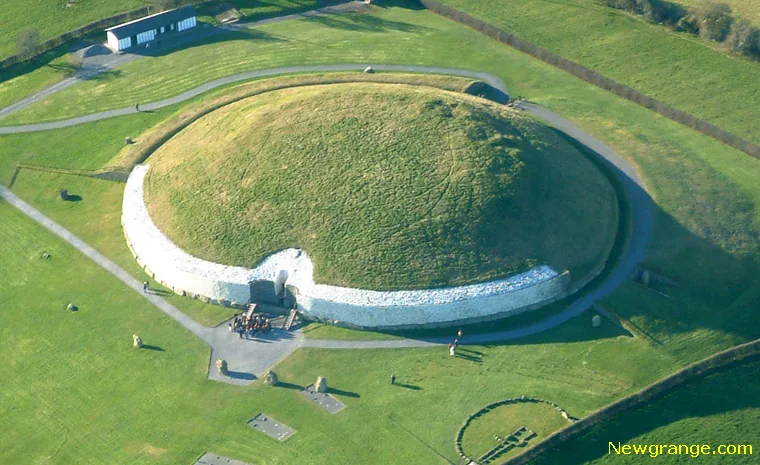 Michael and Myles Gibbons suggest that parts of Newgrange’s mound profile and a possible summit enclosure date to the Iron Age.
A mound built in more than one phase
The Brú na Bóinne Research Framework lists later prehistoric activity at Newgrange as a gap, especially the late Iron Age, from about the first to the fifth centuries AD. David Sweetman showed that rows of pits O'Kelly had left unexplained belong to one great pit circle, older than the stone circle. Charles Mount reads the late Neolithic animal bone as the remains of ceremony around a timber circle to the south east, a smaller timber setting to the west, a bank and the free standing stone circle.
Palle Eriksen argued that the mound was altered more than once and that the mound we see was raised to seal the passage tomb, much as Silbury Hill was raised in southern England. Niels Andersen, following that line, sees a smaller inner barrow later enlarged out to the kerb, hundreds of years after the first tomb. John Ó Néill points to a turf sample from behind kerbstone K96, east of the entrance. It lay several metres down, under stone and turves, and gave a radiocarbon date of AD 259 to 536 (UB-360, 300 ± 45). Quentin Dresser, who analysed the samples, called it too young and blamed younger material slipping through the loose cairn. A lower sample from the same cutting, UB-361, agreed with the Neolithic dates. Ó Néill argues that the upper date may instead mark a late Iron Age rebuilding of the profile, with sods laid over loose stone as at Navan Fort.
Heightening an older mound is known elsewhere. At Kiltierney in County Fermanagh a Neolithic cairn was ditched and raised, and nineteen small satellite mounds were built around it. At Deerpark Farms a seventh century enclosure was raised until it became a flat topped mound with souterrains.
An enclosure and a standing stone
A roughly circular enclosure shows on old aerial photographs and on antiquarian drawings. During conservation the flat top was filled in, though traces can still be seen. A cross section published with the catalogue of Roman coins runs from south west to north east and shows a bank with a slight inner ditch on each side and a slightly mounded interior, so the summit looks like a barrow. Measured on O'Kelly's plan the enclosure is about 40 m (131 feet) across. Geraldine and Matthew Stout give the level area on top as 45 m (148 feet). James Fergusson, working from a late nineteenth century survey, put the platform at 64 m (210 feet) and thought the mound was finished around AD 400, on the strength of the coins, torcs and rings.
Edward Lhwyd, in 1699, described a single standing stone on the summit, smaller than the stones of the great circle and visible from the ground around the mound. It is on an early copy of his drawing. Thomas Molyneux did not mention it, and it is absent from Charles Vallancey's survey and from Gabriel Beranger's watercolour. A sketch of 1855 by W. P. Newenham, who had seen the monuments about 1837, says the stone was undermined and thrown down the mound by men looking for hidden money, and that gold ornaments were found at its base. Louisa Beaufort had also heard of two gold coins under the pillar. O'Kelly left the summit unexcavated, and where the stone went is unknown.
A standing stone on a mound, with or without a ring, is a familiar Iron Age arrangement at Rathcroghan, at the Mound of the Hostages on Tara and on Daithí's mound at the southern edge of the Rathcroghan complex. The date of the Newgrange stone and the enclosure is unknown. The pairing is what leads the authors to suggest an Iron Age date.
Back inside the passage
O'Kelly thought the entrance stayed hidden from a first collapse until the rediscovery of 1699. The authors doubt that. Two unburnt skeletons in the tomb are odd for a Neolithic passage tomb burial, and Geraldine and Matthew Stout suggest a later burial. Two granite objects read as lamps, one from under the basin in the chamber and one from outside, 9 m (30 feet) south of kerbstone K92, may be Iron Age or early Christian once O'Kelly's layers are set aside. A third came from the surface soil near the Boyne.
Lhwyd reported part of a stag's or an elk's head in the cave, which is more than the bone pins that usually explain those words. A dumb-bell of white chalk from the inner chamber matches Iron Age glass and bone toggles from Loughcrew, Knowth and elsewhere. Burnt fragments of a bone pin under the basin in the west recess sit more comfortably in the early medieval centuries than in the Neolithic.
Three dog skeletons, one in the east recess, one in the west and one just outside the end recess, were taken for modern strays because they are large and well preserved. Louise van Wijngaarden-Bakker left open the chance that the bodies were brought in. The paper sets that beside a passage in the tenth century Sanas Cormaic, where a poet chews the flesh of a dog, a cat or a red pig, lays it on a flagstone and calls on the gods. Dog bone turns up in ritual settings at Tara, Haughey's Fort and the King's Stables. The Newgrange dogs are undated. An Iron Age deposit cannot be ruled out.
Coins, gold and horses
Twenty five Roman coins are known from Newgrange. The earliest is a coin of Domitian, minted at Rome about AD 81. The latest is either a solidus of Arcadius from Trier, AD 383 to 387, or a clipped siliqua of AD 364 to 395. Lhwyd found a coin of Valentinian, who ruled from AD 364 to 375, on the summit in 1699. Molyneux recorded two more, one of Valentinian and one of Theodosius, who ruled from AD 379 to 395, taken from the foot of the mound. In 1842, digging near the entrance produced two gold torcs, a brooch, a gold ring and a denarius of Geta, AD 198 to 212.
 Stones of the Great Circle in front of the entrance. Most of the Roman coins and
jewellery were found here and on the ground before the kerb.
Most of the coins, finger rings, brooches, beads, earrings and torc fragments come from those two places. A gold bracelet turned up in a neighbouring field, and more Roman gold in satellite tomb Z. Three gold pendants of Constantine I and Constantine II, probably struck at Trier between about AD 318 and 337, are of a kind more often found beyond the frontier. Roger Bland has suggested they were handed out as subsidies, or as pay to commanders of laeti, foreign troops in Roman service.
A Middle Bronze Age gold torc from the site carries the letters SCBONS.MB on the hook. John Ó Néill reads that as Sacrum Bonis Manibus, an offering to the kindly spirits, or as an abbreviated name plus Sacrum Manibus. Patrick's Confession speaks of jewellery placed on pagan altars. A native torc with a Latin formula points to someone at Newgrange, between the later first century and the late fourth, who knew Roman ways of dedicating an object.
Two horse teeth from what O'Kelly called the late Neolithic and Beaker horizon have been dated to the Irish Iron Age. One falls in AD 67 to 220. The other is most likely 40 BC to AD 80. Wear on one tooth fits a Roman cavalry bit, though an Irish snaffle bit used unevenly could leave the same mark. Horse remains at Ráith na Ríg on Tara, close to the Mound of the Hostages and to Roman material at the Rath of the Synods, are the nearest parallel. Horses, and white mares in particular, sit deep in the later literature of Irish kingship.
The authors describe Knowth's Roman finds, including samian ware, glass, a cosmetic spoon and a stylus, as consistent with domestic occupation. They interpret the rings, chains, necklaces and gold coins at Newgrange as deliberate offerings deposited over much of the Roman occupation of Britain. Catherine Swift reads them as offerings by a native aristocratic class already in touch with Roman Britain. The same habit of leaving coins at older tombs is well known in southern Britain, at West Kennet, at Julliberrie's Grave in Kent and at several Cotswold and Severn long barrows, including Hetty Pegler's Tump beside the temple of Mercury at Uley.
Lydney and the gods of the Brú
Medieval writing ties the mound to the Tuatha Dé Danann, to Cú Chulainn and the Ulaid and to the pagan ancestors of the kings of Ireland. In Tochmarc Étaíne the Dagda fathers Óengus on Bóand inside the Brú, having sent her husband Elcmar away for nine months that felt like a day. Óengus later takes the mound at Samhain. Other texts bury the Dagda there, and the Metrical Dindshenchas has him build it and lie there with the Morrígan. Two hillocks west of the mound are still called the two breasts of the Morrígan.
T. F. O'Rahilly took Nuadu of the silver hand as another name for Elcmar. Dáithí Ó hÓgáin links that god with Nodens, whose temple at Lydney, on the north west shore of the Severn estuary, stands inside an older enclosure and has produced coins, jewellery and inscriptions to Mars Nodens. It was rebuilt in the fourth century, with a mosaic of sea creatures and a copper arm that invites comparison with Nuadu's silver one. Coins from Lydney show a salmon being caught, which Ó hÓgáin sets beside the salmon of knowledge in the Boyne. Óengus's title Mac ind Óc may come from the British and Gaulish god Maponos. The authors suggest that the Laigin, who at times held the Boyne and claimed Tara, may have helped bring Romano-British religious practices to the Boyne Valley. Titles such as trebun, tribune, in early Leinster verse already show Latin borrowed before Christianity.
The same mound was remembered as a place of assembly and of knowledge got from the dead. A twelfth century tale says the green of the Brú was first broken when Muirchertach mac Erca agreed to mark out a church there. In 1084, the Annals of Tigernach say, Óengus Óc told Gilla Lugan the cause of a plague. Gilla Lugan used to haunt the síd every year on Samhain night. John Waddell thinks that síd was Newgrange. At Lydney, pilgrims slept in cubicles in the temple so that a dream interpreter could read what they had seen. The paper treats that as one route by which the habit of sleeping at a tomb could have reached Ireland.
What remains to be tested
The evidence is circumstantial. There is no certain Iron Age settlement on the mound, and several features of other royal inauguration sites are missing, so a role in the making of kings is the least secure part of the argument. Newgrange still belongs with Knowth and Dowth in that late prehistoric world. The authors suggest that the summit enclosure may have been a barrow or a settlement enclosure. The Roman gold and coins found in front of the mound, possible later burials and the remains of horses and dogs lead them to propose that Newgrange may have served as a royal cult centre in the centuries before Christianity.
They ask for a close look at the summit, and for dates on the human and animal bone from O'Kelly's excavations of 1962 to 1975.
Read the paper
Michael Gibbons and Myles Gibbons, 2016. The Brú: a Hiberno-Roman cult site at Newgrange? Emania 23, 67 to 78.