Irish Passage Tombs
Andrew Cochrane's 2006 doctoral thesis, Irish Passage Tombs: Neolithic Images, Contexts and Beliefs, puts the carvings at the centre of Neolithic life in Ireland. They take part in how people made a world, met it and changed it. A spiral on a kerbstone belongs with the mound, the cremated bone and the objects placed in the tomb.
He wrote it at Cardiff University under Alasdair Whittle and submitted it in October 2006. The argument runs through worldviews and the act of looking, then through the Irish Neolithic and then through passage tombs in the east, the north and the south.
Download the full thesis (PDF, 38 MB, 412 pages).
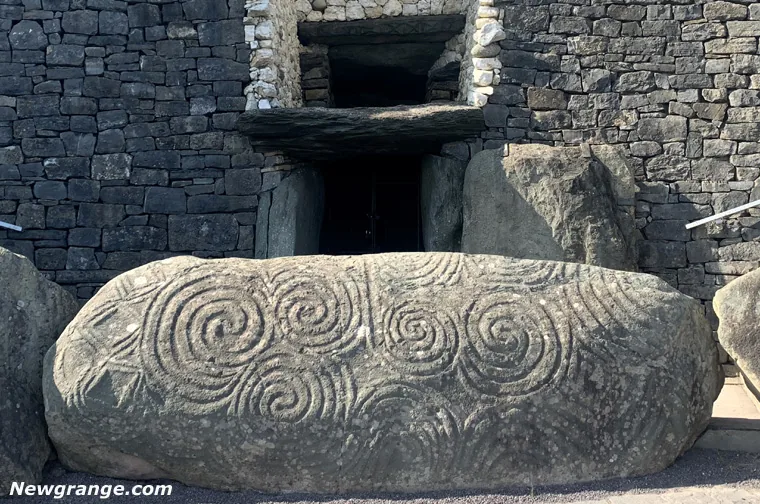 Kerbstone K1 at Newgrange, with the entrance and roof-box behind it.
What the carvings do
A carving is an event. It works on the person who stands in front of it, and that person works on it in return, by looking, by cutting another line, by bringing liquid to the stone. A spiral or a lozenge is not a word in a lost language. Dense patterns can trouble the eye. Where one motif lies over another, the surface stays unfinished. A memory of who cut a line, and why, might last a generation or two and then harden into myth.
He is wary of the phrase "passage tomb culture". It gathers too many different acts under one name. Cosmology, worldview and the feel of a particular place do more for him. Shamanic and totemic traditions from elsewhere show how images can carry a universe with an above, a here and a below. He uses those examples to think with. He does not claim that the Irish tombs are a shaman's script, or that geometric motifs are a transcript of trance.
The chapter on looking draws on visual studies and on neurology. Images are not passive marks waiting for a reader. Some geometric forms can arise in the eye and the brain, and he sets that possibility against real stones. Kerbstone 13 at Knowth is one of them. He prints it plain, and again with digital colour, to ask what a fresher, sharper pattern would have done to someone standing at the kerb. Weathered lines today are gentler than the day they were cut. Paint, if it was used, would have sharpened them further, and rain would have forced people to renew it.
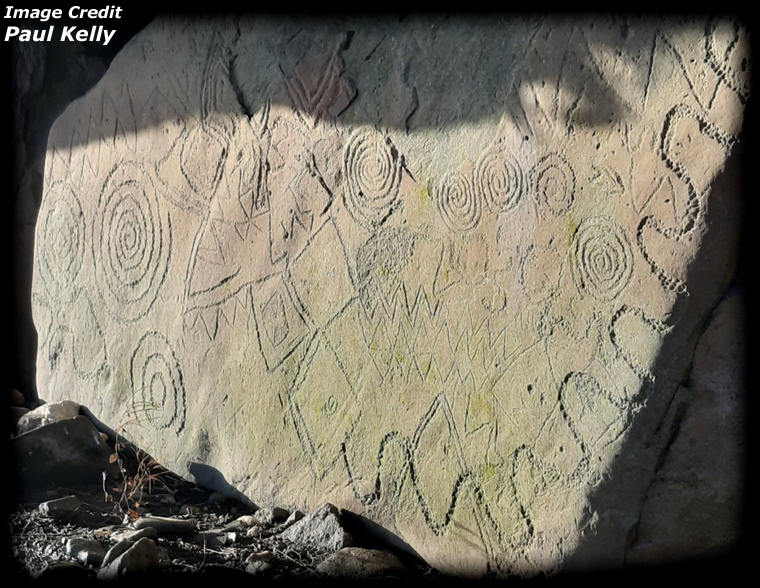 Kerbstone 13 at Knowth. Cochrane uses this stone when he asks what a
dense pattern does to the eye.
A shorter chapter then sets the tombs in time. Stone monuments and passage tombs emerge in the fourth millennium BC. He follows the view that smaller and simpler sites tend to come first, and the large complex mounds later. He is also uneasy with the words ritual and house when they smooth over what people actually did.
The Bend of the Boyne
Knowth, Newgrange and Dowth are the long case study. Each mound can be seen from the other two. Knowth lies about 1.2 kilometres (three quarters of a mile) upstream to the north-west. Dowth is a little over 1.6 kilometres (a mile) downstream. Around them he keeps the smaller monuments in view, among them Townleyhall, Monknewtown and the satellites at Newgrange.
At Knowth, timber buildings under the later mound belong to the centuries before the great tomb, in the late fifth and early fourth millennium BC. The mound itself holds an eastern tomb and a western tomb. He follows Muiris O'Sullivan's sequence of art styles, and the way one carving cuts across an older one. Orthostat 48 in the eastern tomb and orthostat 45 in the western tomb are two of the sequences he follows in detail. On the Boyne mounds, carving on the outside was often done in one episode, with the stone already in place. Carving inside was repeated over a longer time, with angular lines overlain by bolder picking. Circles, round mounds and round settings suggest a sense of time that turns, rather than a straight run from past to future.
The main mound at Newgrange is about 85.3 metres (280 feet) across, with a cruciform chamber. The roof-box sits above the entrance and 2.3 metres (7.5 feet) back from it. With the Mound of the Hostages, this is one of the only two carved passage tombs in Ireland whose main structural stones are still intact and in place. He writes about the quartz at the front as a bright surface that can hold the eye in the same restless way as wet stone, and about K1 set between K2 and K97. Site B, on the lowest terrace above the river, shows how the slope and the water do as much work as the tomb itself. There was no pottery in the main tomb at Newgrange. He reads that absence, beside pots that do turn up elsewhere, as a sign that the sets of objects were improvised.
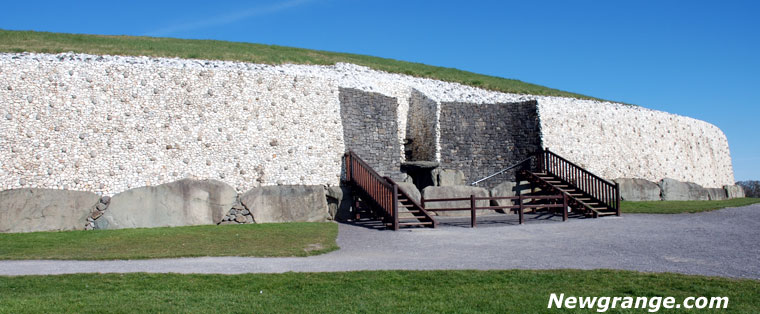 The quartz and cobbles at the front of Newgrange.
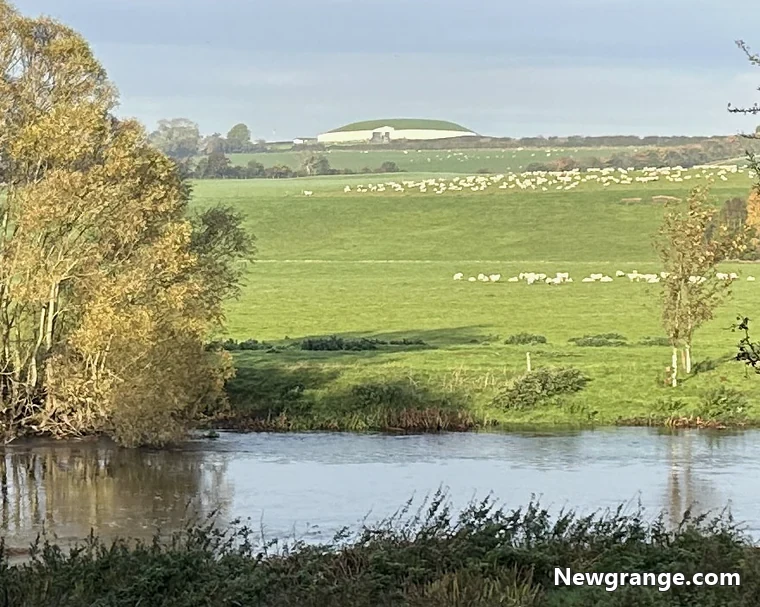 The Boyne in the foreground and Newgrange on the ridge.
Dowth has two tombs, both facing west. The northern one has an annexe off the recess on the right, and a basin stone now sitting in the chamber. The southern tomb carries the winding lines that older writers called serpents. Cochrane would rather see them as flowing water. Outside, the kerb is mostly curves, often cut in a single episode. Inside, the designs are more angular and were reworked. The art sits early in O'Sullivan's sequence, close to Knockroe in County Kilkenny, and the late Boyne habit of pick-dressing is largely absent. At the end of the shortest day the setting sun reaches the passage and chamber, a kinship with Newgrange that he notes without making astronomy the whole account.
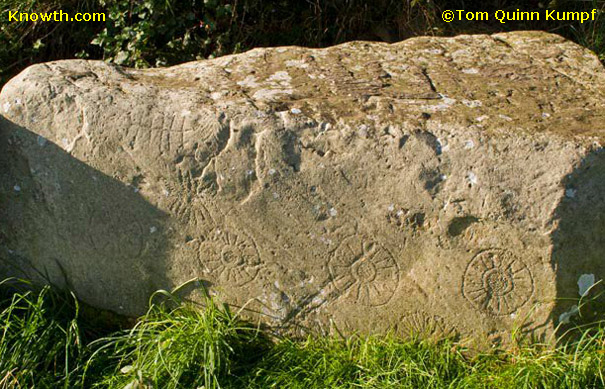 Kerbstone K51 at Dowth, with the sun pattern Cochrane illustrates on the front of
the stone.
Taken together, the three mounds suggest that laying one motif over another was a way of working a worldview back into the present. The carving cites a past and aims at what comes next. He does not insist that people turned their world upside down here. He asks us to follow how the motifs were made, not only the pattern left at the end.
Loughcrew
Loughcrew, or Slieve na Calliagh, spreads across Carnbane West, Carrickbrack, Carnbane East and Patrickstown, about 3 kilometres (2 miles) from east to west and 600 metres (1,970 feet) from north to south. From the hills you can see the Wicklow Mountains, the Mournes and Slieve Gullion. The tombs stand away from daily settlement, and the climb is part of meeting them. Carnbane, the white cairn, may remember quartz used in places such as Cairn T.
He stays with Cairn T and Cairn U on Carnbane East, Cairns F, H, I and L on Carnbane West, and Cairn XI on Patrickstown. Again and again the stress falls on the right side as you go in. At Cairns H and U the cell on the right is the larger one. At Cairns I and L the centre cell is stressed on that side. Basins, a pillar in Cairn L and the richest carving often sit there. Cairn XI is a low ring now, with one strong design still readable, a cup mark and radiating lines like a sunburst, close to Kerbstone 15 at Knowth. Nineteenth-century visitors said it showed best in the setting sun.
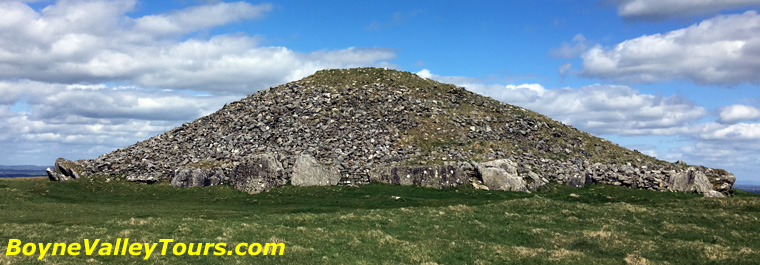 Cairn T on Carnbane East, the cairn Cochrane treats as the focus of that hill.
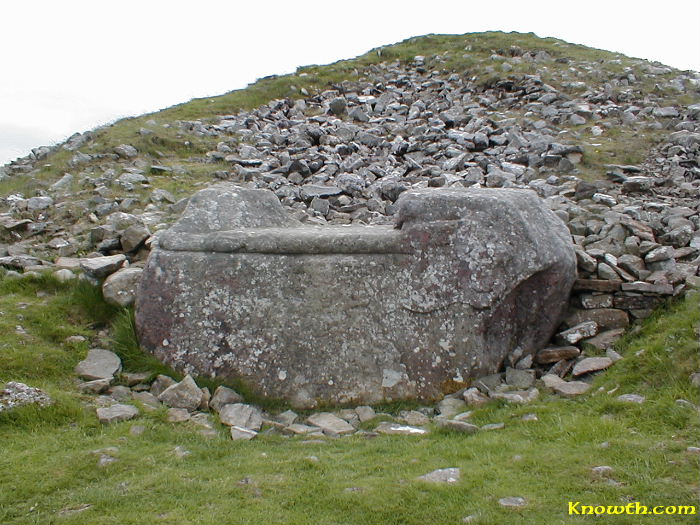 Kerbstone K29 at Cairn T known as the Hag's Chair.
Readings that stay inside the passage and readings that stay on the open hill both remain in play. Julian Thomas described movement inward as more tightly channelled, with the motifs like a text for those allowed far enough in. Fraser argued that the ground between the cairns mattered more, as public theatre. Cochrane keeps both. Inside, the architecture and the carving formalise what happens. Outside, more people can gather than a chamber will hold. Carnival, laughter, eating and the overturning of ordinary rules can loosen what the tomb seems to fix. The images present a world that could be otherwise. They simulate a reality that has no original hiding behind the stone.
Smaller tombs in the north, east and south
The smaller tombs test whether the great eastern cemeteries are an oddity. He takes Fourknocks and the Mound of the Hostages in County Meath, Knockmany and Sess Kilgreen in County Tyrone, and Knockroe in County Kilkenny.
Fourknocks I stands on a ridge near Naul, at 152 metres (499 feet), with a wide view and the Delvin nearby. The Boyne, about 15 kilometres (9 miles) off, is hidden by the Bellewstown ridge. Only Fourknocks I has carvings. One orthostat he treats as a possible clown's face, which feeds the carnival theme. Fourknocks II, the neighbouring mound, is a reminder that these hills have longer and messier histories than a single tomb.
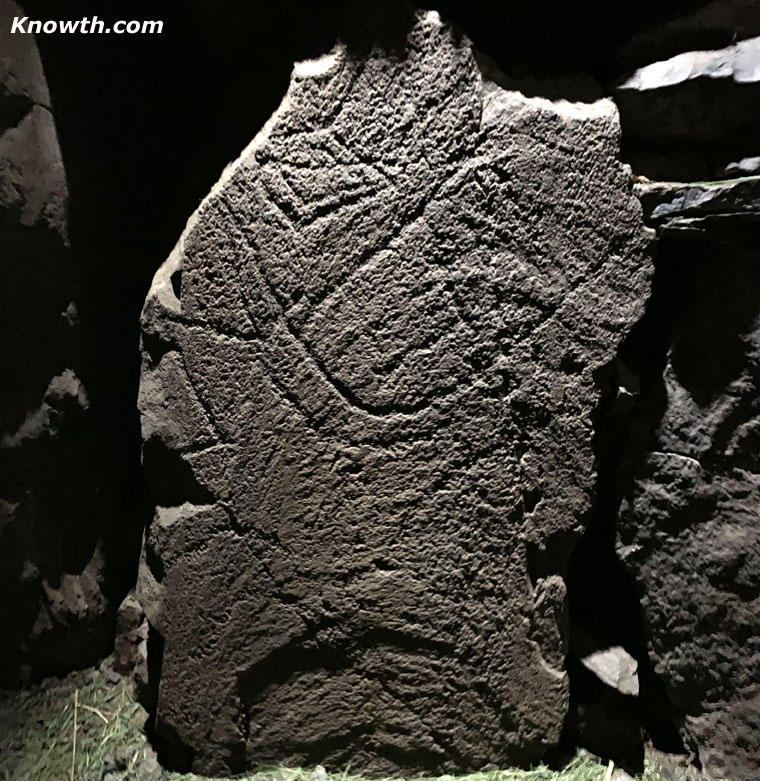 The face stone at Fourknocks. Cochrane asks whether this orthostat, C1, might
be read as a clown's face.
The Mound of the Hostages on the Hill of Tara is small beside Newgrange. Like Newgrange, it still has its structural stones in place. Orthostat L2 is the most richly carved stone in the tomb and does not sit in a neat sequence of styles. Cremation, cists and pots, one of them holding bone and a smaller one empty, show the same loose way of combining things that he finds in the Boyne.
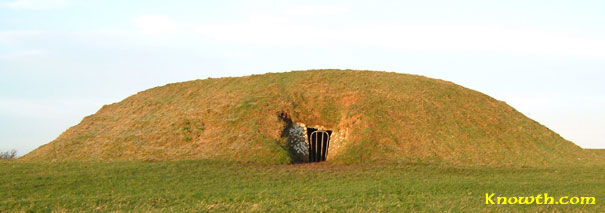 The Mound of the Hostages at Tara.
Knockmany and Sess Kilgreen are hilltop tombs in Tyrone. At Sess Kilgreen he photographed orthostat C6 after pouring milk across it, then washed the milk off. The liquid made a tired carving readable again. He offers that as a way into how liquids may have been used on stone.
Knockroe, looking towards Slievenamon, has two tombs. The western one is aligned on the setting sun. The eastern one is smaller, with early spirals, circles and ovals, quartz in the filling, a large deposit of cremated bone, a miniature macehead and a bowl-shaped pit where a basin might have stood. The art is close in stage to Dowth. Across these smaller sites the same preoccupations turn up at another scale. High ground, an east to west axis, quartz, a limited set of objects, cremated bone, activity at the entrance and a preference for the right side. A mound can echo the hill it stands on, a ditch the rivers, a kerb the mountains on the horizon. The big cemeteries are not a world apart.
Objects and liquids
Carvings without the things placed with them are only half the encounter. Burnt beads and pendants, stone balls, pins, Carrowkeel bowls and axeheads recur, but not as a standard kit. Fourknocks can lack pottery in a closed context. One pot at Tara holds cremated bone and another does not. He takes the objects as participants, not as luggage for the dead. Colour, texture and the mix of substances do work of their own.
The flint macehead from the eastern tomb at Knowth was found on the old ground surface. Its geometric ornament is the sort he compares with K1 and K52 at Newgrange. When it was deposited is disputed. He includes it because the carving and George Eogan's account of the find put it early in the life of the tomb.
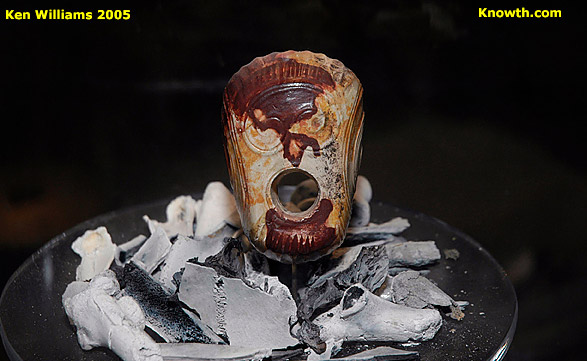 The flint macehead from the eastern tomb at Knowth, shown with cremated
bone.
Liquids are the other half of this. Water on a kerbstone darkens the grooves and seems to set the lines moving. Milk on the Sess Kilgreen stone brings a worn line back. He also names blood and semen, used at particular times and places, as liquids that could charge a motif. People do not control every meeting. Stone, image and object push back.
Conclusions
The closing chapter returns to the opening claim. Imagery belongs in any account of how these societies made themselves. The carvings are a cosmography, not a spare decoration added once the real work was done. Studying them shows social change as uneven, repetitive and full of contradiction.
One Neolithic story would miss the point. A motif blurs the line between what people take to be real and what they have made. It presents, rather than standing in for a meaning kept somewhere else. It can enchant, and it can also mask the chance that there is nothing hidden behind it. Laying a later image over an earlier one is how another generation refreshes a worldview whose original has gone. Motifs at Sess Kilgreen, Knockmany, Tara and Knockroe seem to belong to a single phase, and the lack of overlay there means fewer returns to the stone, not a different kind of image. Each generation still meets the tomb with its own understanding.
He calls the settings stages and islandscapes, places set apart as an island is set apart. Carnival there can overturn a belief and also keep it going. Talk and myth about why these places are special become part of the next version of the world. Visiting a tomb is itself a performance. The architecture still tells a living person how to move.
Representation can stay. It should not be the only habit, and a visual and cosmological reading can stand beside it. The diagram that closes the thesis sets bone, hills, time, motifs, water, place, quartz, pottery, stone and the cosmos in one field. Open-air rock art, a fuller account of circular time and comparisons with Millin Bay, Lyle's Hill, Cloverhill, Anglesey, Scotland and Brittany are left for later. The thesis is a beginning.
Download the full thesis (PDF, 38 MB, 412 pages). Andrew James Cochrane, Cardiff University, 2006.
Further papers by Andrew Cochrane
- Irish Passage Tomb Motifs
- We Have Never Been Material
- A taste of the unexpected: subverting mentalités through the motifs and settings of Irish passage tombs